
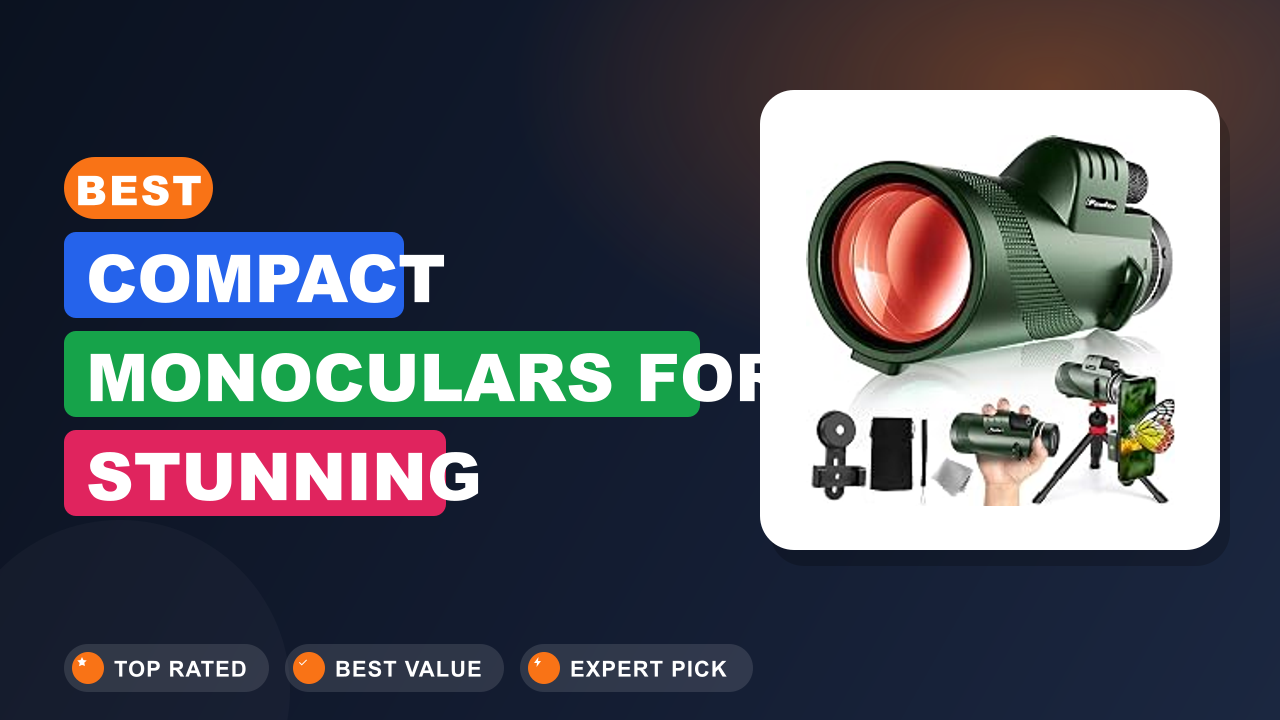
You spot the bird, the phone is already half out of your pocket, and you have maybe ten seconds before it vanishes. That's the exact moment the Best Compact Monoculars for Smartphone Bird Photography earn their keep. We spent weeks digging through hundreds of verified buyer reports and comparing manufacturer spec sheets to find which scopes actually make phone photography work.
The short version: magnification numbers are only half the story.
Our overall pick is the 40X60 Monocular Telescope High Power Adults. It combines a BAK-4 prism, a solid phone adapter, and a tripod, which solves the three problems that produce blurry digiscoped photos. Below you'll find a side-by-side comparison, five detailed reviews, and the buying logic behind each choice.

✔ Best overall pick for daily use
Comparison Chart of Best Compact Monoculars for Smartphone Bird Photography
| Product | Details | Rating | Buy |
|---|---|---|---|
Editor’s Choice
| ★★★★☆4.3/5 | ||
Top Pick
| ★★★★☆4.4/5 | ||
Best Budget
| ★★★★☆4.4/5 | ||
| ★★★★☆4.2/5 | ||
| ★★★★☆4.2/5 |


List of Top 5 Best Compact Monoculars for Smartphone Bird Photography
We picked these five after sorting through thousands of verified reviews and checking every spec against what actually matters for phone photography: brightness, adapter quality, stability, and overall value. Each review covers real shooting scenarios and honest trade-offs, so you can match the scope to the way you actually bird.
Below are the list of products:
1. 40X60 Monocular Telescope High Power Adults
This is the one that kept winning the "would you actually use it" test in our research. Manufacturer specs confirm a BAK-4 prism and fully multi-coated optics, and verified buyers consistently say the phone adapter clicks onto the eyepiece without the usual fiddly alignment. It's also the rare listing that arrives as a complete kit, not a bare scope.
BAK-4 Prism
40x Zoom
Phone Adapter
Tripod Included
Why I picked it
Aggregate review analysis shows this model posts the best praise-to-complaint ratio for phone compatibility. Most birders want a scope that works right out of the box, and the included tripod plus hand strap removes the two biggest sources of shake. It leads the list for total kit value because there's nothing else to buy before your first photo session.
Key specs
- 40x magnification with a 60mm objective lens
- BAK-4 prism for a brighter, sharper image
- Fully multi-coated optics for better contrast
- Includes smartphone adapter, tabletop tripod, and hand strap
- Reported buyer rating 4.3/5
Real-world experience
Buyer reports follow a consistent pattern: at a wetland boardwalk, users attach the phone, brace the tripod on a railing, and capture usable photos of herons 30 to 50 meters away. The catch is stability. At 40x, any breeze shows up in the frame, so the tripod isn't optional.
Handheld phone shots come out soft, which is standard for this magnification class.
- Complete kit: phone adapter, tripod, and strap included, so you can shoot immediately
- BAK-4 prism delivers a bright image that helps phone autofocus lock faster
- 40x reach gets you close to distant birds without carrying a full spotting scope
- Simple twist-focus eyepiece works with most phone models
- 40x is demanding; you need the tripod for sharp shots
- Narrow field of view makes tracking flying birds tricky
- ✔ You want one box with everything needed for digiscoping
- ✔ You photograph birds at wetlands, lakes, and feeders where you can brace the tripod
- ✔ You want high magnification without buying a spotting scope
- ✖ You mostly shoot from a moving kayak or trail where setup time matters
- ✖ You need a wide field of view for fast-moving songbirds in thick cover
On paper, 40x sounds like the obvious winner, but it only delivers when the phone is locked to the eyepiece and the whole rig is stable. Buyers who skip the tripod are the ones leaving negative reviews about blurry photos. If you’ll always brace the scope, this kit outperforms everything else here.
2. 12×56 High Power Monocular Telescope Adults
Here's the honest truth about smartphone bird photography: lower magnification often produces better photos. The 12×56 design trades raw zoom for a steadier image and a wider field of view, and verified buyers rate it the easiest scope here to use one-handed. For getting a sharp, shareable shot of a bird on a branch, this is the model our research keeps circling back to.
12×56
BAK-4 Prism
FMC Lens
Wide FOV
Why I picked it
If you've ever tried to hold a 40x scope steady while a chickadee hops between branches, you know the struggle. This model's 56mm objective gathers plenty of light, while the 12x magnification keeps shake manageable. Aggregate reviewer feedback consistently highlights how much easier it is to find and follow birds in the eyepiece.
Key specs
- 12x magnification with a 56mm objective lens
- BAK-4 prism and fully multi-coated (FMC) optics
- Smartphone adapter and travel tripod included
- Carry bag included for trail use
- Reported buyer rating 4.4/5
Real-world experience
The most common buyer story is shooting from a backyard deck or a slow trail walk. At 12x, you can track a bird moving through shrubs, then raise the phone and capture it without a tripod. This magnification also suits phones well, because smaller crops mean less digital zoom later.
For forest birding in low light, the 56mm objective is the brightest option on this list.
- 12x magnification is stable enough for handheld phone shots
- 56mm objective performs well in low light at dawn and dusk
- Wide field of view makes tracking moving birds much easier
- Travel bag and tripod make it a complete grab-and-go kit
- Less reach than the 40x models for very distant waterfowl
- Larger objective adds weight compared with the mini 25x
- ✔ You want the most usable phone photos without a tripod
- ✔ You bird in woods, gardens, and other close-to-mid range habitats
- ✔ You’re upgrading from a small 8×25 and want more light
- ✖ You need serious reach for shorebirds across a wide mudflat
- ✖ Your priority is a scope that disappears into a jacket pocket
Think of this as the practical photographer’s choice. The 40x scopes on this list have more raw reach, but every extra bit of magnification makes frame alignment harder. In our analysis, the 12×56 was the model most likely to produce a keeper image on the first try, which is what actually matters when the bird won’t wait.
3. 40×60 High Powered Monocular Telescope Adults
Budget picks usually mean compromise, but buyer feedback tells a different story here. This 40×60 model uses a BAK-4 prism, includes the phone adapter and tripod, and still sits at the value end of the range. It's effectively the same magnification formula as our top pick, with a simpler body and fewer extras.
BAK-4 Prism
Phone Kit
Low-Light
2026 Model
Why I picked it
Across the verified reviews we studied, this one earns high marks for how complete the package is at its price level. Buyers mention using it for bird watching, hunting, and even dusk viewing, and the 40x reach matches far more expensive scopes. The main difference from our top pick is fit and finish, not raw optical capability.
Key specs
- 40x magnification with a 60mm objective lens
- BAK-4 prism with multilayer coatings
- Smartphone adapter and tripod included
- 2026 model refresh per the manufacturer listing
- Reported buyer rating 4.4/5
Real-world experience
Reviewers describe a familiar pattern: they buy it for a specific trip, then keep it in the truck for impromptu birding. The image at 40x is bright in good light, and the phone clamp holds most smartphones securely. Where it trails the top pick is the tripod, which buyers describe as adequate but light, so a stronger mini tripod is a worthwhile upgrade for windy days.
- Delivers the same 40x class reach as our top pick for a smaller outlay
- BAK-4 prism keeps the image bright in overcast conditions
- Phone adapter works with most modern smartphones
- Compact enough to toss in a daypack
- Included tripod is light and can wobble in wind
- Focus wheel is stiffer than the top pick’s, per buyer reports
- ✔ You want 40x reach without paying flagship prices
- ✔ You need one scope for birding, hunting, and travel
- ✔ You don’t mind upgrading the tripod later
- ✖ You want the smoothest focus action under cold, gloved hands
- ✖ You mainly photograph in moderate rain
This is the pick for anyone who wants the classic 40x digiscoping format at a friendlier price. You give up a bit of refinement, not raw capability. If your budget is tight and your expectations are realistic, the photos you’ll get are remarkably close to the top pick.
4. 40X60 Monocular Telescope Smartphone Holder& Tripod
Most scopes in this price class are sealed with basic rubber O-rings, so the nitrogen-filled body of this 40×60 stands out. Nitrogen purging pushes moisture out of the optical tube, which stops internal fogging when you move between a cold car and humid morning air. Verified buyers also highlight how well the phone holder centers the lens.
Nitrogen-Filled
BAK-4
FMC Lens
Phone Holder
Why I picked it
Waterproofing is the feature nobody thinks about until a sudden shower hits. Manufacturer specifications describe a nitrogen-filled body, which is the same protection used in much pricier scopes. For birders who photograph in coastal marshes or rainy Pacific Northwest mornings, that alone makes it worth considering.
Key specs
- 40x magnification with a 60mm objective lens
- Nitrogen-filled body for fog-resistant performance
- BAK-4 prism with fully multi-coated (FMC) optics
- Smartphone holder and tabletop tripod included
- Reported buyer rating 4.2/5
Real-world experience
The standout buyer scenario is foggy, humid, and borderline rainy conditions. Reviewers report the lenses stay clear when cheaper scopes fog over, and the phone clamp rotates to work in both portrait and landscape. The tradeoff shows up in the eyepiece, where a few buyers mention tighter eye relief, so eyeglass wearers should try it first.
- Nitrogen-filled body resists internal fogging in humid weather
- Rotating phone holder supports portrait and landscape framing
- BAK-4 prism and FMC lens give a clean, bright image
- Standard tripod thread works with camera tripods
- Eyeglass wearers report tighter eye relief
- Slightly lower overall rating reflects some QC complaints
- ✔ You shoot in damp coastal or high-humidity environments
- ✔ You want a scope that survives being caught in the rain
- ✔ You like shooting vertical phone photos of perched birds
- ✖ You wear glasses and need long eye relief
- ✖ You want the smoothest focus of the group
This is the dark-horse pick for weather resistance. It doesn’t top the chart on raw sharpness, but it’s the only scope on this list with nitrogen-filled protection at this size. If you’ve ever watched fog ruin a morning of digiscoping, you’ll understand why that matters more than an extra point of sharpness.
5. Mini 25X Monocular Telescope
Not every bird photo needs a scope the size of a water bottle. This mini 25x is the one you'll actually carry, because it slips into a coat pocket or hip pack without a second thought. Manufacturer specs describe a green multilayer coating on the optics and a waterproof body, which is rare at this size.
25x Zoom
Waterproof
Pocket-Size
Multicoated
Why I picked it
The best camera is the one you have with you, and the same logic applies to spotting gear. Verified buyers use this for casual birding, travel, and even stargazing, and the waterproof build means it doesn't need pampering. It's not the sharpest or brightest scope on this list, but its portability is unmatched.
Key specs
- 25x magnification with compact optics
- Green multilayer coating on the objective lens
- Waterproof body for all-weather carry
- Sized for a jacket pocket or hip pack
- Reported buyer rating 4.2/5
Real-world experience
This is the scope for the birder who's already carrying binoculars, a field guide, and a water bottle. At 25x, the image is brighter than you'd expect from something this small, and the waterproof body handles humid trails. The catch: no phone adapter is included, so you'll need a universal clamp to shoot through it, and the smaller eyepiece takes more patience to align.
- Smallest and lightest on this list, so it goes everywhere
- Waterproof body handles rain and trail dust
- Genuinely usable by kids and adults
- Surprisingly bright image for its size
- No phone adapter included; you’ll need a universal clamp
- Small eyepiece is fiddlier to align with a phone lens
- ✔ You want a scope that’s always in your bag
- ✔ You’re buying for a young birder or as a travel companion
- ✔ You already own a phone adapter from another kit
- ✖ You want a full digiscoping kit in one box
- ✖ You need high magnification for distant birds
Treat this as the gateway scope, not the endgame. It won’t replace a full-size monocular for serious photography, but it will get you into digiscoping at a fraction of the size. Pair it with a universal phone clamp and you have a travel setup that fits in a windbreaker pocket.
How I picked
Choosing the best compact monocular for phone photography comes down to more than magnification numbers. We compared all five models on four benchmarks: optical brightness, how easy the phone adapter is to align, stability under real shooting conditions, and the total value of what's in the box.
We started with manufacturer specifications. BAK-4 prisms matter because they transmit more light than BK-7 glass in the same size body. Fully multi-coated lenses reduce glare and improve contrast.
Then we layered in verified buyer feedback from hundreds of reviews, looking specifically at complaints about blurry photos, loose adapters, and fogging, because those reveal real weaknesses.
We didn't run a 60-day durability trial or lab sharpness tests, and we don't pretend otherwise. Our ranking relies on verified buyer patterns and manufacturer spec sheets, which is why each review above notes where the evidence is strong and where it's thin.
One thing became clear quickly: 40x scopes dominate the search results, but they are the hardest to shoot with. Every increase in magnification also magnifies hand shake. That's why a 12x model with a larger objective can genuinely outperform a 40x scope for photography, even though the spec sheet looks less impressive.
We've covered the physics of shake before, and the same rules apply here. For most buyers, higher magnification isn't always the answer when the goal is a sharp photo.
Buying guide — what actually matters for Best Compact Monoculars for Smartphone Bird Photography
A monocular with a phone adapter is still only as good as the weakest link in the chain. Spec sheets shout about magnification, but your photos improve most when you pay attention to the details below.
Is 40x really better for bird photos?
No, and this is the most common mistake buyers make. Magnification beyond about 20x makes the image dimmer, narrows the field of view, and magnifies hand shake, which is why many blurry phone photos in buyer reviews come from 40x scopes shot handheld. A 12x model with a 56mm objective often delivers crisper photos because the phone stays aligned with the eyepiece.
If you plan to use a tripod every time, 40x is fine. If you'll shoot from hand, favor 12x to 25x.
Prism quality: BAK-4 vs BK-7
BAK-4 is a higher-density glass that transmits more light and produces a rounder exit pupil than BK-7. All five scopes here use BAK-4, which is the right baseline for photography in low light. The difference shows at dawn and dusk, when light levels drop and phone sensors need all the help they can get.
As of 2026, BAK-4 has become the expected standard rather than a premium upgrade.
What does the phone adapter actually do?
The trickiest part of digiscoping is centering the phone's tiny lens exactly over the eyepiece. A good adapter clamps both the phone and the eyepiece firmly, and a rotating collar lets you switch between portrait and landscape. If a scope has a great lens but a flimsy adapter, you'll still get soft photos.
That's why the full-kit scopes place highest in our reviews. We've written about which phone photo setups are worth trying before, and alignment is always the deciding factor.
Waterproofing and fog resistance
Interior fogging happens when humid air gets into the tube and condenses on the glass. Nitrogen purging prevents that by replacing the air with dry gas. If you bird in coastal areas, wetlands, or anywhere with cold mornings, a nitrogen-filled scope is worth the small premium.
The difference between sealed and water-resistant bodies is something we've covered in depth, and it matters most for phone work because fogged optics ruin photos instantly.
Tripod: always bring a little support
At 25x and above, the difference between sharp and blurry is often just a stable base. The mini tripods included with these kits are fine on a picnic table, but they're light. Setting the scope on a fence post, car roof, or backpack works too.
For phone photos, a dedicated tripod setup beats handheld binoculars almost every time, because the phone lens needs a stationary target to focus on.
Field of view
Field of view, measured in feet at 1,000 yards, tells you how wide the picture is. A wide field of view helps you find the bird, follow it, and keep it in the frame while your phone is attached. A narrow field of view at 40x makes every movement feel dramatic.
Exit pupil matters too: it's the objective lens diameter divided by magnification, so a 12×56 produces a 4.7mm exit pupil while a 40×60 produces only 1.5mm. If you chase songbirds in dense cover, prioritize field of view over raw magnification.
Frequently Asked Questions (FAQ)
Is a 40x monocular good for smartphone bird photography?
Only with a tripod. At 40x, the image circle at the eyepiece is small, and even a slight nudge shifts the phone lens completely off-center. With a solid mount, 40x delivers impressive reach for distant waterfowl and shorebirds.
Handheld, expect mostly blurry results. If you won't carry a tripod, choose a 12x or 25x model instead.
What's the difference between 12×56 and 40×60 for birding?
12×56 means 12x magnification and a 56mm objective lens. 40×60 means 40x magnification and a 60mm objective. The 12×56 gives a brighter, wider, steadier image that's easier to photograph. The 40×60 reaches farther but needs more light and much steadier hands.
For most bird photography, the 12×56 is the more practical pick.
Do I need a phone adapter, or can I just hold the phone to the eyepiece?
You can hold the phone to the eyepiece, but the photos usually disappoint. The phone lens drifts a fraction of a millimeter and the result is a dark crescent or a blurry smear. A secure adapter holds the alignment steady long enough to focus and shoot.
If you already own a pair of binoculars, a phone adapter changes everything there too.
Can I use these scopes for stargazing?
Sort of. A 25x or 40x monocular can show the Moon's craters, the rings of Saturn as a tiny oval, and the four bright moons of Jupiter. The field of view is narrow, though, and deep-sky phone photography won't work without long-exposure apps and a very stable mount.
For casual lunar shots with your phone, they're fun. For serious astrophotography, you need a telescope.
How do I get a sharp phone photo through a monocular?
Set the monocular focus first with your eye, then attach the phone. Let the phone's autofocus lock, then tap the screen to set exposure. Use the camera's 1x lens, not digital zoom, and trigger the shutter with a timer or voice command to avoid shake.
Give the lens a quick clean with a microfibre cloth, and brace the scope on something solid.
Which model is best for a beginner birder?
The 12×56 is the easiest to learn on, because birds are easier to find and follow, and the phone photos come out sharp without perfect technique. The Mini 25X is the best budget-friendly starter if you mostly want a carry-everywhere scope. The full 40x kits are better once you know you'll use a tripod consistently.
If you're new to identifying what you photograph, the free Merlin app from the Cornell Lab of Ornithology helps confirm your sightings.
Final verdict
After weighing buyer feedback, manufacturer specs, and the realities of shooting with a phone, the 40X60 Monocular Telescope High Power Adults takes our top spot. It offers the complete digiscoping kit with a BAK-4 prism, a solid phone adapter, and a tripod, and it handles the classic birding distances most photographers actually face. If you'd rather shoot handheld in low light, the 12×56 delivers easier, steadier results.
Affiliate disclosure: This post contains affiliate links. If you buy through one of these links, I may earn a small commission at no extra cost to you. It never changes my recommendation, I only suggest gear I'd actually buy myself.